By day six in Seoul, my legs were shot, my phone battery was constantly draining from subway transfers, and my head was buzzing from the endless noise of Hongdae and Gangnam. Don’t get me wrong — I love Seoul. But after a week of 25,000 steps a day on concrete, I just wanted to see open water.
So I booked a morning KTX ticket, grabbed an iced coffee and a triangle kimbap at Seoul Station, and headed south.
Two and a half hours later, you step off the train in Busan, walk out of the station, and the first thing you notice is the air. It’s cooler, heavier, and smells distinctly of salt and tide.
Here’s an honest rundown of the trip: how the train works, what’s actually worth seeing, and where to eat on a quick coastal escape.
Getting There: Easy KTX Transit
The bullet train from Seoul to Busan is smooth and efficient:
- Book through the official Korail site (\
letskorail.com\) or KorailTalk app. Avoid third-party reseller sites with inflated fees. A standard one-way seat is roughly \₩59,800\(~$44). - Book 3 to 5 days ahead for weekends. Friday evening and Sunday return trains fill up fast.
- Travel time: Just under 2 hours and 40 minutes on the high-speed line from Seoul Station.
- Your T-Money card works everywhere. Subways, buses, taxis — the exact same card from Seoul works seamlessly across Busan.
1. Haeundae Beach: Early Mornings Are the Sweet Spot
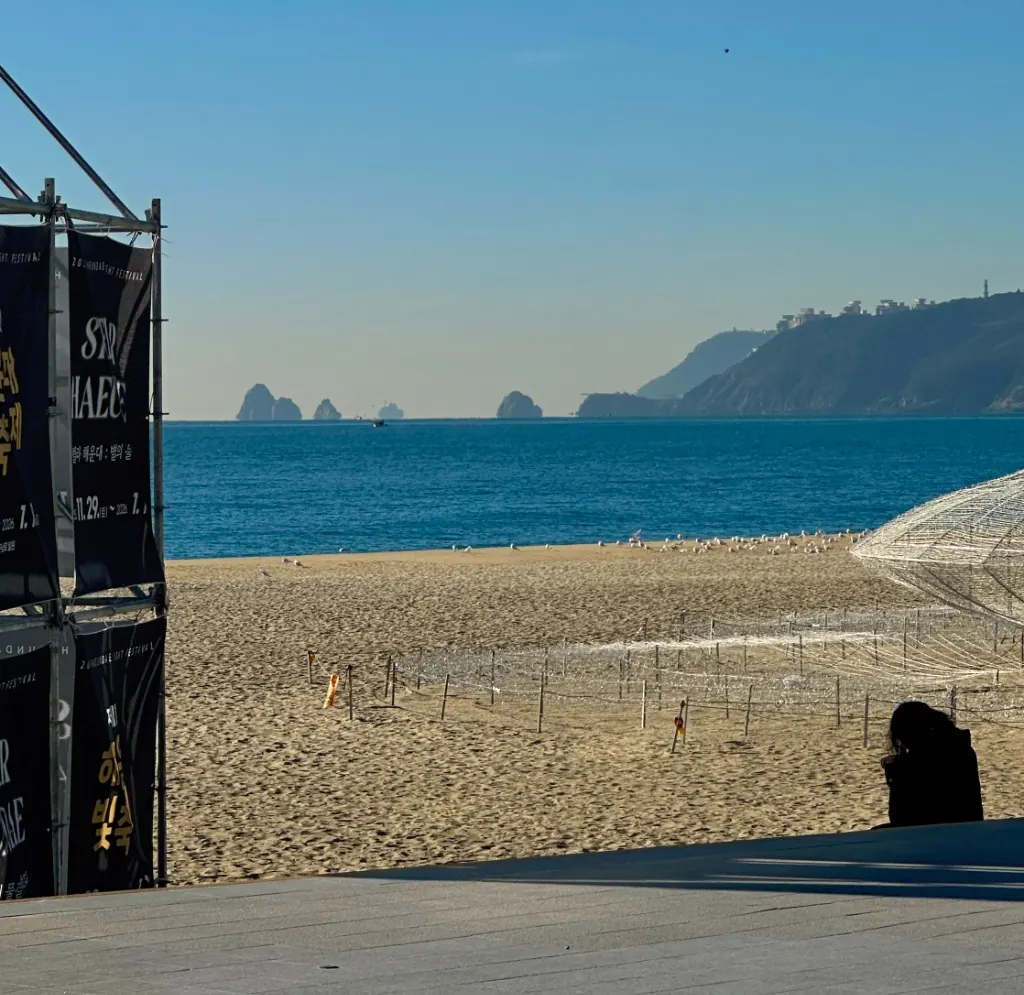
Most travelers base themselves around Haeundae, and for good reason. The wide crescent beach offers open horizons that immediately break Seoul’s urban intensity.

If you want the shoreline to yourself, head out by 8:00 AM. By afternoon, the boardwalk fills with crowds. Early morning is peaceful: rolling surf, local joggers, and seagulls resting on the damp sand. In the distance, the rocky silhouette of Dongbaekseom Island stands against the morning haze.
After walking the shoreline, we headed up to the boardwalk for coffee.
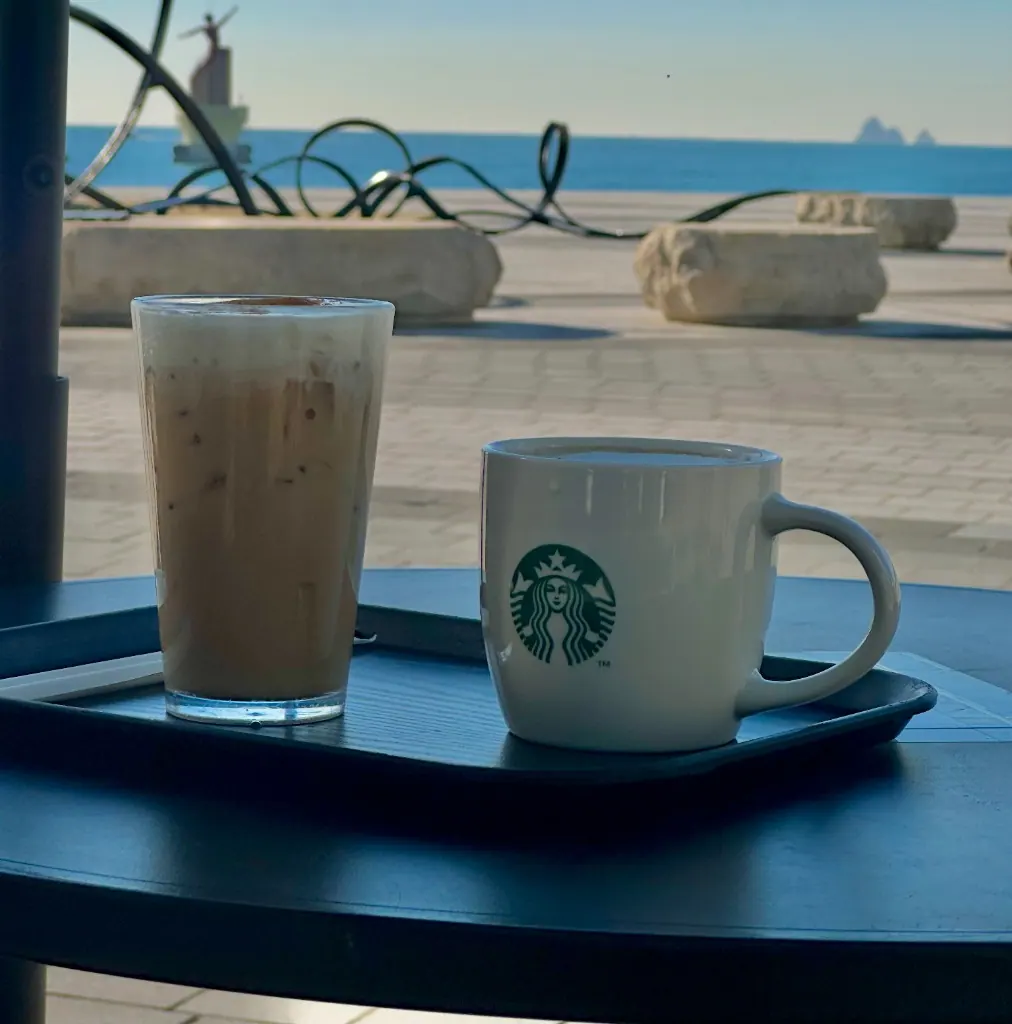
Sitting outside with an iced latte and hot Americano, holding a warm cup while a cool ocean breeze sweeps off the water, was easily one of the best moments of the trip. No itinerary rush — just watching the waves roll in.
2. Haedong Yonggungsa: A Temple Hanging Over the Waves
Unlike almost every other historical temple in Korea hidden away in quiet mountains, Haedong Yonggungsa was built in 1376 directly onto rugged coastal cliffs facing the open sea.
From Haeundae, hail a \Kakao T\ taxi (about 15–20 minutes and \₩12,000\). You can also take bus \181\, but the taxi saves significant time.
The 108 Steps Down
After passing traditional street stalls and zodiac sculptures, you enter a pine-framed stairway of 108 stone steps. According to Buddhist tradition, each step represents letting go of one of life’s 108 worldly worries. As the roar of crashing surf grows louder, the mental reset feels very real.
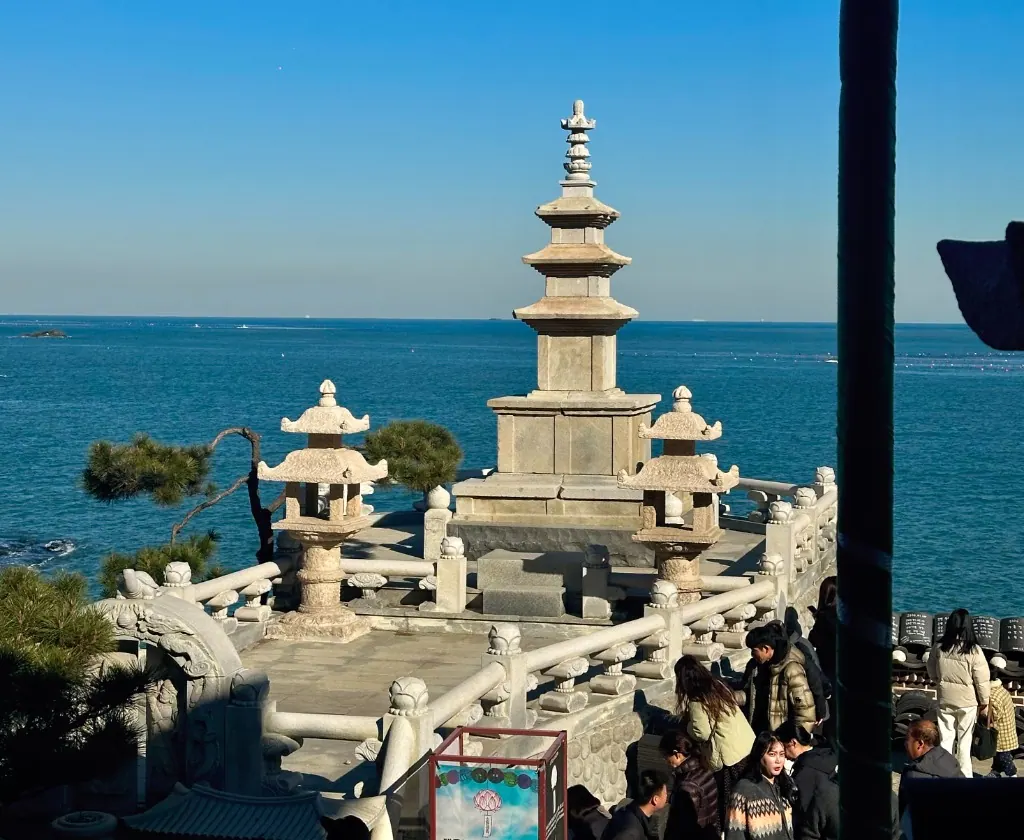
At the base, the coastline opens up dramatically. The three-story stone pagoda stands perched over the churning sea, watched over by four carved stone lions.
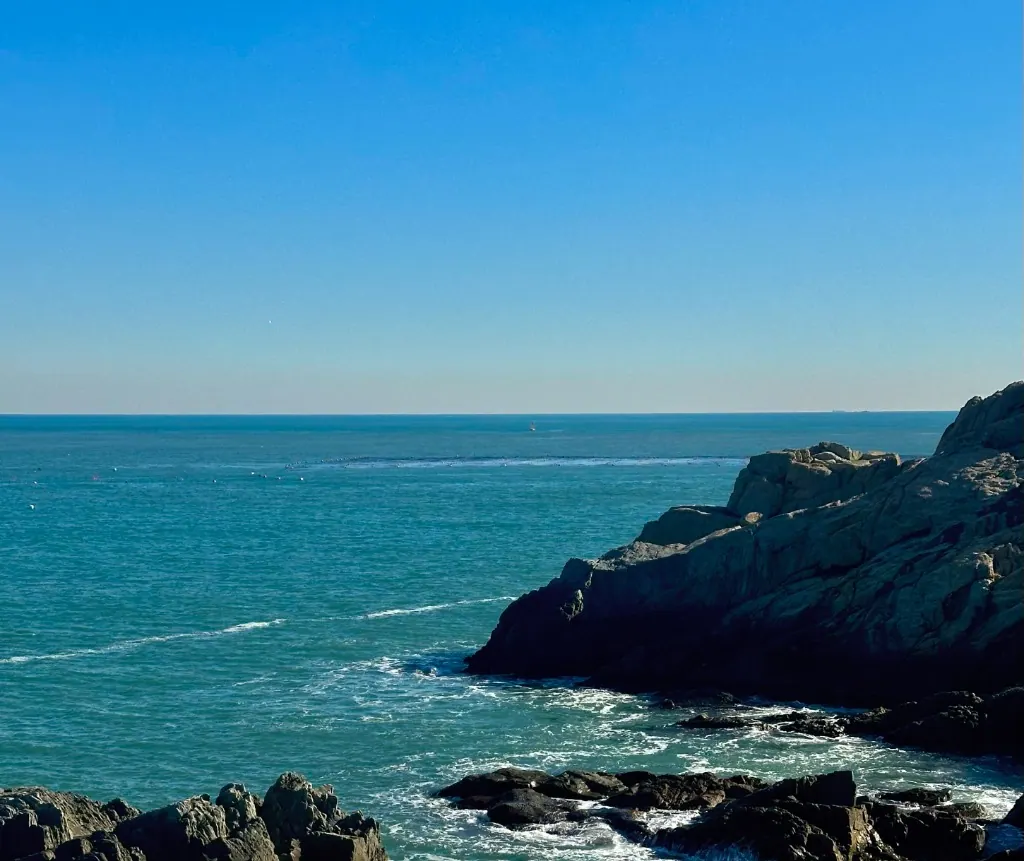
Walking onto the coastal bridge offers an unforgettable view of ancient temple roofs set against deep blue waters.
3. The Lantern Canopy & Golden Wish Leaves
Stepping into the main sanctuary courtyard, you walk beneath an elaborate ceiling of hundreds of vibrant lotus lanterns in deep purple, gold, and jade.
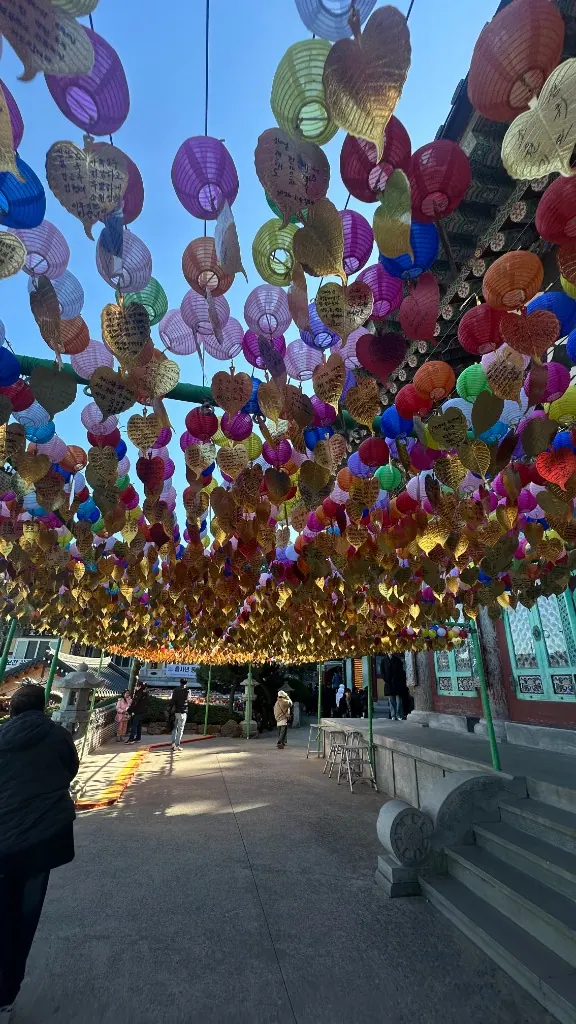
Draped beneath them are thousands of metallic gold wishing leaves called Sowon-ji (소원지), inscribed with personal hopes: family health, exams, and safe travels. You can pick up a gold leaf for \₩5,000\, write your wish with a marker, and tie it to the cords.
Essential Busan Eats
Busan food is hearty and heavily shaped by port life:
1. Dwaeji Gukbap (돼지국밥): Busan’s signature dish — steaming pork bone soup with tender sliced pork. It arrives unseasoned: add salted fermented shrimp (\saeujeot\), red chili paste (\dadaegi\), and fresh chives (\₩9,000 – ₩10,000\). 2. Ssiat Hotteok (씨앗호떡): Crispy fried sweet pancakes stuffed with roasted sunflower seeds, pumpkin seeds, and brown sugar syrup at BIFF Square (\₩2,500\). 3. Jagalchi Fish Market: Pick live seafood on the ground floor and enjoy fresh hoe (sashimi) or spicy fish stew upstairs.
3 Quick Tips Before Visiting
- Use Naver Map: Google Maps does not provide walking navigation in South Korea due to local regulations. Naver Map supports English and handles bus, subway, and walking routes.
- Don’t rush the distances: Busan is geographically spread out. Dedicate one day to the East (Haeundae, Yonggungsa) and another to the West (Jagalchi, Gamcheon).
- Pack a windbreaker: Coastal winds off the sea can feel brisk compared to central Seoul.
The Verdict
If you have 8 to 10 days in Korea, dedicating two nights to Busan completely transforms your journey. Seoul brings electric neon energy, but sitting on Haeundae with morning coffee and listening to temple bells over the waves gives you the perfect contrast.